
Block Form Letter
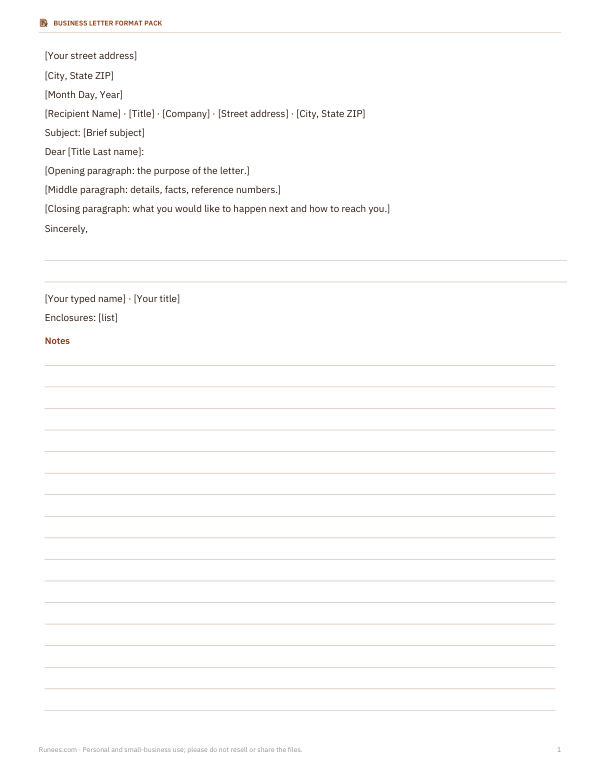
Full block is the most common business letter format: every line starts at the left margin, with a blank line between parts. This maker assembles the parts in the correct order — your address, date, inside address, subject, salutation, body, closing and signature block — and shows the same letter in modified block and semi-block so you can see the difference before printing.
- Free to use
- No sign-up
- Runs in your browser
Block letter maker
Business Letter Format Pack
Editable business letter templates in full block, modified block and semi-block formats, a letterhead template, an envelope addressing guide and a letter writing checklist.
- Full block template (DOCX/PDF)
- Modified block template (DOCX/PDF)
- Format comparison (PDF)
- Letter checklist (PDF/DOCX)
Formats: DOCX, PDF. Instant download after payment (link valid 72 hours, up to 5 downloads). AI-assisted: the templates were drafted with AI help and reviewed and laid out before publishing.
$5.00 USD, one-time 4 files · about $1.25 each
- Instant download
- 7-day refund
- Secure checkout by Stripe
7-day money-back guarantee. Full refund within 7 days of purchase, even after you download.
Free sample: Full Block Letter Template (PDF, 57 KB)
Full refund within 7 days — see the refund policy and license.
Free printables
Single sheets you can print right now, no sign-up. The full pack adds every sheet in one download plus the editable files.
 Printable Business Letter Checklist
The parts of a block letter, in order
| Part | What to write | Spacing after |
|---|---|---|
| Sender’s address | Your street address and city (not your name) — omit on letterhead | 1 blank line |
| Date | Month written in full: September 30, 2026 (US) or 30 September 2026 (UK) | 1 blank line (some styles use 3) |
| Inside address | Recipient’s name, title, company and address | 1 blank line |
| Subject line (optional) | “Subject:” or “Re:” and a few words | 1 blank line |
| Salutation | “Dear Ms. Shah:” (US business uses a colon; UK uses a comma or none) | 1 blank line |
| Body | Single-spaced paragraphs, blank line between | 1 blank line |
| Complimentary close | “Sincerely,” — only the first word capitalised | 3–4 blank lines for signature |
| Signature block | Typed name, then title on the next line | 1 blank line |
| Enclosures / cc | “Enclosures:” list; “cc:” names | — |
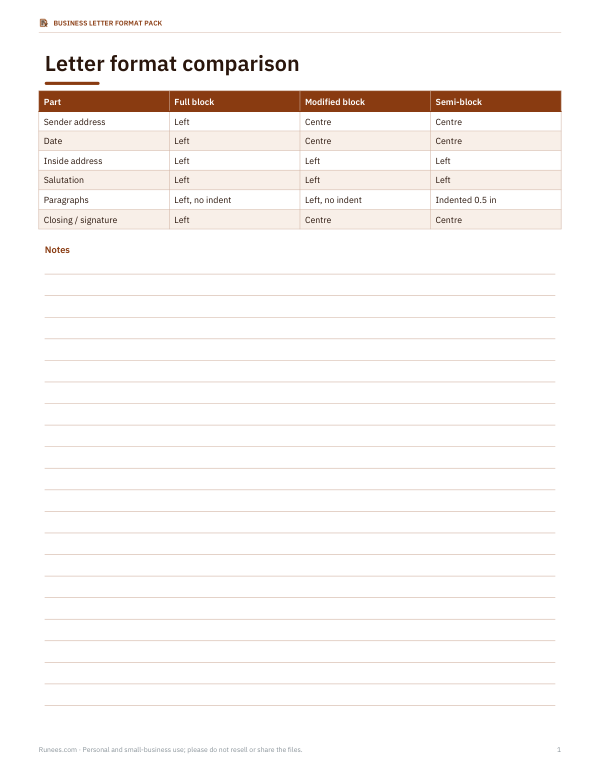
Full block vs modified block vs semi-block
| Format | Alignment | When it’s used |
|---|---|---|
| Full block | Everything flush left; no indents | Most common in business; easiest to type |
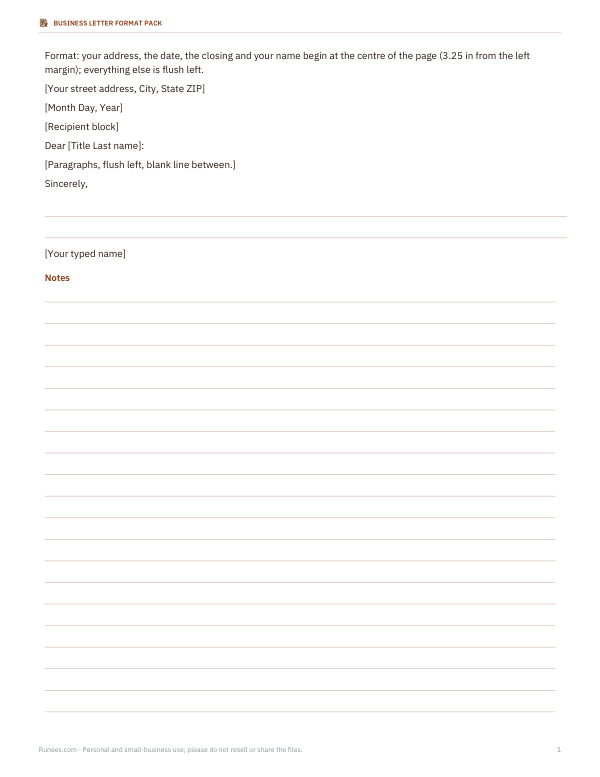
| Modified block | Sender’s address, date, closing and signature start at the centre; paragraphs flush left | Traditional, still common for personal business letters |
| Semi-block | Like modified block but each paragraph indented 0.5 in | Less formal; some personal correspondence |
All three use single spacing within paragraphs and a blank line between paragraphs. Choose one format and apply it consistently.
Margins, fonts and length
- Margins of 1 inch (2.5 cm) on all sides are standard; up to 1.5 in if the letter is short.
- Use a readable 10–12 pt font such as Times New Roman, Georgia, Arial or Calibri.
- Keep business letters to one page where possible — three or four short paragraphs.
- If a letter runs to a second page, put the recipient’s name, date and page number at the top of page 2.
- Print on plain white paper or letterhead and sign in ink between the closing and your typed name.
Writing the body
- First paragraph: why you’re writing — the purpose in one or two sentences.
- Middle paragraph(s): the details and facts the reader needs, such as dates, order numbers and what happened.
- Final paragraph: what you want to happen next, by when, and how to contact you.
Be specific and polite. Include reference numbers the reader can look up. If you are enclosing documents, mention them in the body and list them after the signature.
Worked example: a complaint letter in full block
Jordan writes to a customer relations manager about a damaged dishwasher. The letter starts with Jordan’s street address and the date at the left margin, then the manager’s name, title, company and address. A bold subject line gives the order number. “Dear Ms. Shah:” opens three short paragraphs — what was bought and what was wrong, what Jordan would like done and what is enclosed, and how and by when to reply. “Sincerely,” is followed by space for a signature, Jordan’s typed name and an enclosure line listing the receipt and photos. Switching to modified block moves the address, date, closing and name to the centre line.
Salutations and closings
| Situation | Salutation | Closing |
|---|---|---|
| Named recipient | Dear Ms. Shah: / Dear Dr. Lee: | Sincerely, / Yours sincerely, |
| Name unknown (US) | Dear Hiring Manager: / Dear Customer Service Team: | Sincerely, |
| Name unknown (UK) | Dear Sir or Madam | Yours faithfully, |
| Formal / official | Dear Judge Rivera: / Dear Senator Lee: | Respectfully, |
| Friendly business | Dear Priya, | Best regards, / Kind regards, |
“To Whom It May Concern” is still used for general references and certificates, but a role title such as “Dear Hiring Manager” feels more personal when you don’t know the name.
Common letter types in block format
| Letter | Key content |
|---|---|
| Complaint | What you bought, what went wrong, what you want, deadline |
| Cover letter | Role, why you fit, a specific achievement, request for interview |
| Resignation | Position, last working day, thanks, handover offer |
| Request | What you need, why, by when |
| Thank-you (business) | What you are thanking them for and its impact |
| Inquiry | Who you are, what you want to know, how to reply |
Whatever the purpose, the block format stays the same — only the body changes.
US and UK conventions
US business letters write dates as month-day-year and use a colon after the salutation. British letters usually write day-month-year, may omit punctuation after the salutation and closing (“open punctuation”), and pair “Dear Sir or Madam” with “Yours faithfully” and a named salutation with “Yours sincerely”. The maker uses US conventions; adjust the salutation and closing fields for British style.
Privacy
Letters are assembled in your browser; nothing you type is uploaded or saved.
Frequently asked questions
What is a block form letter?
A letter in which every line, including the date and closing, starts at the left margin, with no paragraph indents.
What is the difference between block and modified block?
In modified block, the date, closing and signature begin at the centre of the page.
How many spaces between the closing and name?
Leave three or four blank lines for your handwritten signature.
Do you indent paragraphs in a block letter?
No — paragraphs are flush left with a blank line between them.
Where does the subject line go?
After the inside address and before the salutation.
Is my letter saved?
No. It stays in your browser until you print, copy or download it.
What font size should a business letter use?
Usually 10–12 point in a readable font such as Times New Roman, Arial or Calibri.